Sunday, June 5, 2011

Shunryu Suzuki on Living In The Dark, Empty Sky.

We should always live in the dark, empty sky.
The sky is always the sky.
Even though clouds and lightning come,
The sky is not disturbed.
Even if the flashing of enlightenment comes,
Our practice forgets all about it.
Then it is ready for another enlightenment.

Shunryu Suzuki, "Zen Mind, Beginner's Mind"

Sunday, May 22, 2011

Chopra on Lenses of Perception

By itself, nothing “out there”
Has any definition without a perceiver.
When scientists claim to have deciphered
The mechanics of vision,
All they have done is found a map,
Which must not be mistaken for reality.

Everyone has seen photographs
Of what the world looks like
Through the multiple eye of a bee, spider, or fly.
Each of these insects sees through more than one lens,
And the photographs therefore present a cluster
Of eight or ten of twenty images, generally of a flower,
And we are to suppose that the insect brain
Sees the flower that way.

These composites, however, do not really capture
The actual experience of insect eyesight,
They only indicate what a human being might see
If he looked through several camera lenses
At the same time.

If all perception is personal,
Where do the “real”
Sights, sounds, smells, tastes, and textures begin?
We trust our eyes to see “real” photons
And our ears to hear “real” vibrations in the air,
But it is easy to show that
This trust rests upon a very shaky foundation.

Why don’t we all see voices,
Instead of restricting ourselves
To the same worn rut of hearing?
Many deaf people do “hear” the wind in the trees
When they see the branches swaying.
Some junction point in their minds
Converts a visual signal into an auditory one.
Many blind people can likewise “see” faces
By feeling them with their hands.

A mental junction point has taken the signals of touch
And converted them to sight.
Presumably our brains could do the same thing,
But we prefer to let habit and memory take over.
We see through our eyes and feel through our fingers
Because we have been conditioned to do so.

Sunday, May 15, 2011

Chih-men's koan

What thing is not attained when painstakingly sought?
What thing comes of itself without being sought?
What thing does not break under the blow of an iron hammer
What thing closes by night and opens by day?
- Chih-men

Sunday, May 8, 2011

Prajnaparamita


Subhuti asked: "Is perfect wisdom beyond thinking? 
Is it unimaginable and totally unique but nevertheless
Reaching the unreachable
And attaining the unattainable?"

The Buddha replied: "Yes, Subhuti, it is exactly so.
And why is perfect wisdom beyond thinking?
It is because all its points of reference
Cannot be thought about but can be apprehended.
One is the disappearance of the self-conscious person
Into pure presence.
Another is the knowing of the essenceless essence
Of all things in the world.
And another is luminous knowledge

None of these points can sustain ordinary thought
Because they are not objects or subjects.
They can't be imagined or touched
Or approached in any way
By any ordinary mode of consciousness,
Therefore they are beyond thinking."
- Prajnaparamita

Sunday, March 27, 2011

Chopra on the New Body Paradigm

Here are some vast assumptions,
The makings of a new reality,
Yet all are grounded in the discoveries of quantum physics
And made almost a hundred years ago.
The seeds of this new paradigm were planted by
Einstein, Bohr, Heisenberg,
And the other pioneers of quantum physics,
Who realized that the accepted way
Of viewing the physical world was false.

1. The physical world, including our bodies,
Is a response of the observer.
We create our bodies as we create
The experience of our world.
2. In their essential state, our bodies are composed of
Energy and information, not solid matter.
3. The mind and body are inseparably one.
The unity that is “me” separates
Into two streams of experience.
I experience the subjective stream
As thoughts, feelings, and desires.
I experience the objective stream as my body.
At a deeper level, however, the two streams meet
At a single creative source.
It is from this source that we are meant to live.
4. The biochemistry of the body is a product of awareness.
Beliefs, thoughts and emotions
Create the chemical reactions
That uphold life in every cell.
5. Perception appears to be automatic,
But in fact it is a learned phenomenon.
The world you live in,
Including the experience of your body,
Is completely dictated by how you learned to perceive it.
If you change your perception,
You change the experience of your body and your world.
6. Impulses of intelligence create your body
In new forms every second.
What you are is the sum total of these impulses,
And by changing their patterns, you will change.
7. Although each person seems separate and independent,
All of us are connected to patterns of intelligence
That govern the whole cosmos.
Our bodies are part of a universal body,
Our minds an aspect of a universal mind.
8. Time does not exist as an absolute, but only eternity.
What we call linear time is a reflection
Of how we perceive change.
If we could perceive the changeless,
Time would cease to exist as we know it.
9. Each of us inhabits a reality lying beyond all change.
Deep inside us, unknown to the five senses,
Is an innermost core of being, a field of non-change
That creates personality, ego and body.
This being is our essential state–it is who we really are.
10. We are not victims of aging, sickness, and death.
These are part of the scenery, not the seer,
Who is immune to any form of change.

Monday, March 21, 2011

Chopra on The Defense of Self-image and The Loss of Energy

Over the years you have built an idealized self-image
That you defend as “me.” In this image are packed
All the things you want to see as true about yourself;
Banished from it are all the shameful, guilty,
And fear-provoking aspects
That would threaten your self-confidence.

But the very aspects you try to push away return
As the most insistent, demanding voices in your head.
The act of banishment creates the chaos
Of your internal dialogue,
And thus your ideal erodes
Even while you are doing everything
To look good and feel good about yourself.

To really feel good about yourself,
Renounce your self-image.
Immediately you will find yourself being more open,
Undefended, and relaxed.

Much time is spent in self-help trying to turn
A bad self-image into a good one.
As reasonable as that sounds,
All self-images have the same pitfall:
They keep reminding you of who you were,
Not who you are.
The whole idea of I, me, and mine
Was erected on memories,
And these memories are not really you.
If you release yourself from your self-image,
You will be free to choose as if for the first time.

Self-image keeps reality away,
Particularly at the emotional level.
Many people don’t want to admit
What they are actually feeling.
Their self-image dictates that being angry, for example,
Or showing anxiety is not permissible.
Such feelings don’t accord with
The “kind of person I want to be.”

Certain emotions feel too dangerous to be part of
Your ideal image of yourself,
So you adopt a disguise that excludes those feelings.
Deep-seated rage and fear belong in this category,
But sadly so does immense joy, ecstasy,
Or freewheeling spontaneity.

You stop being ruled by self-image when:
You feel what you feel,
You are no longer offended by things,
You stop appraising how a situation makes you look,
You don’t exclude people you feel superior or inferior to,
You quit worrying about what others think about you,
You no longer obsess over money, status, and possessions,
And you no longer feel the urge to defend your opinions.

Sunday, March 13, 2011

The Pearl of Great Price - I Ching

Remain silent, and you sink into a realm of shadows;
Speak, and you fall into a deep pit.
Try, and youre as far away as sky from earth;
Give up, and youll never attain.
Enormous waves go on and on,
Foaming breakers flood the skies.
Who has the bright pearl that calms the oceans?               

Saturday, March 5, 2011

Deepak Chopra on The Gap Between Thoughts


Finding the silent gap that flashes
In between our thoughts
Seems relatively easy, but because it flashes by,
A tiny gap is not a doorway.
The quantum body is not separate from us–it is us–
Yet we are not experiencing it right now.
Sitting here, we are thinking, reading, talking,
Breathing, digesting, and so on,
All of which happens above the line.

Here is an analogy that brings the quantum mechanical
Body into focus: take a bar magnet and place a piece
Of paper over it. Next, sprinkle iron filings on the paper
And jostle it slightly.

What will emerge is a pattern of curving lines,
One inside the other,
That arch from the magnet’s north to south pole
And back again.
The overall design you have made represents a map
Of the magnetic line of force
That otherwise would be invisible, except that
The iron particles automatically align themselves
To bring out the image.

In this analogy, we see all mind-body activity
Above the paper and the hidden field of intelligence below.
The iron filings moving around are mind-body activity,
Automatically aligning with the magnetic field,
Which is intelligence.

The field is completely invisible and unknowable
Until it shows its hand
By moving some bits of matter around.
The piece of paper is the quantum mechanical body,
A thin screen that shows exactly
What patterns of intelligence are being manifested
At the moment.

There is more to this simple comparison
Than you might at first suppose.
It is really the hidden field that is generating
These lifelike appearances.
Here you have a picture of how the body-mind
Actually relates to the field of intelligence.
The two remain separated, but the division is invisible
And has no thickness whatever.
It is just a gap.

The only way one knows
That the quantum level even exists
Is that images and patterns keep cropping up everywhere
In the body.

Friday, February 25, 2011

The Treatise of The Golden Lion, by Fazang

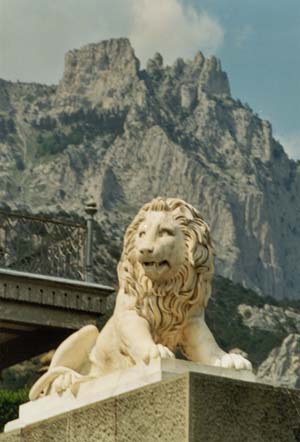
The renowned Buddhist ideologue Fazang (Fa-tsang) (643–712 CE) stands as one of the foremost figures of the golden age of Chinese Buddhism. During his life he lectured tirelessly on the Flower Garland Sutra, the Buddha’s first sermon upon attaining enlightenment. Nearly incomprehensible, The Flower Garland Sutra is invested with a profundity and wisdom unparalleled in the Buddha’s subsequent works. Fazang, condensing the entire abstract doctrine of this sutra into ten parts, brilliantly demonstrated it through the metaphor of a golden lion. The lion represents the cosmos, parts of the lion the various phenomena of the universe, while the gold represented emptiness. The lion had a mane, teeth, claws and eyes: parts that seemed distinct and unrelated. And yet the essential substance of the entire lion was the same–gold. Within each hair, paradoxically, there are infinite lions. The differences are all superficial. Such is the nature of the integrated, interconnected Flower Garland universe. 

The Treatise of  The Golden Lion

1. To understand the principle of dependent-arising.
2. To distinguish form and Emptiness.
3. To summarize the three characters.
4. To reveal the non-existence of forms.
5. To explain the truth of the unborn.
6. To discuss the five doctrines.
7. To master the ten mysteries.
8. To embrace the six forms.
9. To achieve the perfect Wisdom of Bodhi.
10. To enter into Nirvāna.

1. To understand the principle of dependent-arising. This is to say that gold has no inherent nature of its own (i.e., no Svabhāva). It is owing to the artistry of the skillful craftsman that the form of the lion arises. This arising is the result solely of the cause-conditioning; therefore it is called the arising through dependent-arising.

2. To distinguish form and Emptiness. This means that the form of the lion is unreal; what is real is the gold. Because the lion is not existent, and the body of the gold is not non-existent, they are called form/Emptiness. Furthermore, Emptiness does not have any mark of its own; it is through forms that Emptiness is revealed. This fact that Emptiness does not impede the illusory existence of forms is called form/Emptiness.

3. To summarize the three characters. Because of men's delusory perceptions, the lion seems to exist in a concrete manner; this is called the character of universal imagination (parikalpita). The manifestation of the lion appears to be existing, this is called the character of dependency on others (paratantra). The nature of gold never changes, this is called the character of perfect reality (parinispanna).


4. To reveal the non-existence of forms. This is to say that when the gold completely takes in the lion, there is no form of lion to be found. This is called the non-existence of forms.

5. To explain the truth of the unborn. This means that at the very moment when we see the lion come into existence, it is actually the gold that comes into existence. There is nothing apart from the gold. Although the lion may come into and go out of existence, the substance of gold, in fact, never increases or decreases. This is called the truth of the unborn.

6. To discuss the five doctrines. The first: although the lion is a dharma produced through dependent-arising, it undergoes generation and destruction in each and every moment. Since nothing in the phenomenal world endures, no form of the lion can ever be found. This is called the teaching for the ignorant Śrāvakas (Hīnayāna).The second: all things, being the product of dependent-arising, are devoid of Selfhood (Svabhāva), and in the final analysis, are nothing but Emptiness. This is called the preliminary teaching of Mahāyāna.

The third: although all things are Emptiness through and through, this does not impede the vivid appearance of the Māyā/becoming. All that which is of dependent-arising is fictitiously existent and therefore it is truly void. This co-existence of both being and non-being is called the final teaching of Mahāyāna.

The fourth: inasmuch as these two characters that of Emptiness and that of form mutually annul each other, they are both abolished. Here, no imaginings or false presuppositions exist; neither the concept of Emptiness nor the idea of existence retains any influence. This is the sphere in which the ideas of both being and non-being vanish. It is a realm that names and speech cannot reach. Here the mind rests without any attachment. This is called the instantaneous teaching of Mahāyāna.

The fifth: when all false feelings and wrong ideas are eliminated, and the true substance is revealed, everything becomes merged into one great mass. Great functions then arise in abundance, and whatever arises is absolutely true. The myriad manifestations, despite their variety, interpenetrate without confusion or disarray. The all is the one, for both are empty in substance. The one is the all, for cause and effect clearly manifest themselves without fail. In their power and functions the one and the all embrace each other. They spread out and roll up in utter freedom. This is called the Round Doctrine of the One Vehicle.


7. Mastering the ten mysteries. The first: the gold and the lion are simultaneously established, all-perfect and complete. This is called the principle of simultaneous completeness.

The second: if the eyes of the lion take in the complete lion, then the all the whole lion is the eyes. If the ears take in the complete lion, then the all is the ears. If all the organs simultaneously take in the whole lion and all are complete in their possession, then each and every organ is "mixed" (involving others) as well as "pure" being itself. This is called the principle of full possession of the purity and mixture by the various storehouses.

The third: the gold and the lion both establish and include each other in harmony. There is no obstruction between one and many. In this complete mutual inclusion, the Li (noumenon) and the Shih (phenomena), the one and the many, remain in their own positions. This is called the mutual inclusion and differentiation of one and many.

The fourth: all the parts of the lion, down to the tip of each and every hair, take in the whole lion in so far as they are all gold. Each and every one of them permeates the eyes of the lion. The eyes are the ears, the ears are the nose, the nose is the tongue, the tongue is the body. They all exist in total freedom without obstruction or impediment. This is called the mutual identity of all dharmas in freedom.

The fifth: if we look at the lion as a lion, there is only lion and no gold. This is the disclosure of the lion but the concealment of the gold. If we look at the gold as gold, there is only gold and no lion. This is the disclosure of the gold but the concealment of the lion. If we look at both simultaneously, they are both manifest or hidden. Being hidden they are secret, being manifest they are revealed. This is called the simultaneous establishment of disclosure and concealment in secrecy.

The sixth: the gold and the lion may be manifest or hidden, one or many, pure or mixed, powerful or powerless. The one is the other. The principal and the companion interchange their radiance. Both Li and Shih simultaneously come into view. Being mutually compatible, they do not impede one another's existence. This is true even in the case of the minute and the subtle aspects and is called the peaceful co-existence.. of the minute and the subtle.

The seventh: in each of the lion's eyes, in its ears, limbs, and so forth, down to each and every single hair, there is a golden-lion. All the lions embraced by each and every hair simultaneously and instantaneously enter into one single hair. Thus in each and every hair there are an infinite number of lions. Furthermore, each and every hair containing infinite lions returns again to a single hair. The progression is infinite, like the jewels of Celestial Lord lndra's Net; a realm-embracing-realm ad infinitum is thus established, and it is called the realm of lndra's Net.

The eighth: the lion is spoken of in order to indicate men's ignorance; the gold is spoken of in order to reveal the true nature. By jointly discussing Li and Shih, the Ālaya Consciousness is described so that a correct understanding of the doctrine may be reached. This is called the creation of understanding by revealing the Dharma through facts.

The ninth: the lion is a transient and conditioned thing (samskrta dharma); it arises and fades away at every moment, and each moment can be divided into past, present, and future. Each of these three periods again contains three sections of past, present, and future; therefore, altogether there are three-times-three units, thus forming the nine ages; grouping them together we have a total gate to the Dharma-truth. Although there are nine ages, each is different from the other, and yet their existences are established because of one another. They are harmoniously merged without the slightest obstruction in one identical eternal moment. This is called the different formation of separated dharmas in ten ages.


The tenth: the gold and the lion may be manifest or hidden, one or many, but they are both devoid of a Self-being (Svabhāva). They manifest in various forms in accordance with the turning and transforming of the Mind. Whether we speak of them as Li or Shih, there is the Mind by which they are formed and exist. This is called the universal accomplishment through the projection of Mind-Only.

8. To embrace the Six Forms. The lion represents the character of wholeness, and the five organs, being various and different, represent diversity. The fact that they are all of one dependent-arising represents the character of universality. The eyes, ears, and so on remain in their own places and do not interfere with one another; this represents the character of particularity. The combination and convergence of the various organs makes up the lion; this represents the character of formation. The fact that each organ remains at its own position represents the character of disintegration.

9. To achieve the perfect Wisdom of Bodhi. "Bodhi," in the Chinese language, means the Way (Tao) or Enlightenment. This is to say that when we look at the lion, we see at once that all conditioned things, without going through the process of disintegration, are from the beginning in a state of quiescent non-existence. By being free from both clinging and detachment, one can follow this path into the ocean of omniscience (sarvajña); therefore it is called the Way. To comprehend the fact that from the very no-beginning all illusions are in reality non-existent is called Enlightenment.

10. To enter into Nirvāna. When we look at the lion and the gold, the marks of both are exhausted. At this point, the passion-desires no longer arise even though beauty and ugliness are displayed before one's eyes. The mind is tranquil like the sea; all disturbing and delusory thoughts are extinguished, and there are no compulsions. One emerges from bondage and is free from all hindrances. The source of all suffering is forever cut off, and this is called entering into Nirvāna.


Thursday, May 20, 2010

Chopra on recycled patterns

When we consider our physical bodies,
We discover that we are, really,
A collection of recycled molecules.
Cells of our body are created, die,
And are replaced many times throughout our lives.
We are constantly remaking ourselves.

In order to regenerate, our bodies
Convert the food we eat
Into basic building blocks of life.
The earth itself provides the nutrients
We need to renew ourselves,
And when we shed cells,
They are returned to the earth.
We might say, then, that we are
Constantly transforming our physical bodies
By recycling earth.

Next, consider our emotions.
Emotions are just recycled energy.
Emotions do not originate with us.
They come and go
Depending on situations, circumstances,
Relationships, and events.

Emotions are never created in isolation;
They always come about because of
Some interaction with the environment.
In the absence of circumstances or relationships,
There is no emotion.
So even though I may fly into a rage,
It is not actually my anger.
It is anger that has settled on me for the moment.
Each emotion is dependent on the context,
Circumstances, and relationships
That define your reality at that moment.

And what about our thoughts?
Well, our thoughts are recycled information.
Every thought we have is actually part
Of a collective database.
All but the most original thoughts
Are actually quantum leaps of creativity
That occur from that same collective,
Recycled bed of imagination.

So if our bodies are recycled earth,
Our emotions are recycled energy,
And our thoughts are recycled information,
What is it that makes you an individual?
According to many of the great spiritual traditions,
One of the great truths is that “I am the other.”
Without the other, we would not exist.

Sunday, May 2, 2010

Chopra on dreams and ego

We’re all clinging to images of ourselves
That pile up year after year.
Some images make us look good,
Some make us look bad.
But images can’t substitute for the real things.
The real you is vital and alive,
Shifting and changing at every moment.

In everyone’s life, the ego extends its lease
By saying, “Hold on. Keep trying. I know what to do.”
But stand back and consider
What this strategy comes down to:
If all your hard work hasn’t brought you what you want,
Work harder.
If you don’t have enough,
Get more.
If your dream fails,
Keep following it.
If you grow insecure,
Believe in yourself more.
Never acknowledge failure; success is the only option.

This kind of ego motivation,
Turned into slogans,
Is deeply ingrained in popular culture.
Following your dream and never giving up
Has become a credo repeated by
The rich, famous, and successful.
Yet for every winner of a beauty pageant,
Stock-car race, World Series, or Hollywood audition,
There are an untold number whose dream
Didn’t come true.
They followed their dream just as hard
And believed in it just as much.
By no means did the ego’s strategy work for them.

Fortunately, there’s another way;
It’s the exact opposite of the ego’s strategy:
If all your hard work hasn’t brought you what you want,
Look for new inspiration.
If you don’t have enough,
Find it in yourself.
If your dream fails, and you see that it was a fantasy,
Find a dream that matches your reality.
If you grow insecure,
Detach yourself from the situation
Until you find your center again.
You are not shaken by either success of failure;
The flow of life brings both, as temporary states.

The real self is a shifting, elusive phantom
That’s always one step ahead of us.
It dissolves the instant you think you’re about to grab it.
You can’t ever nail down who you really are.
To understand your real self,
You have to keep up as it moves.
Finding the real you happens on the run.
The same holds true for grace, since it is part of the real you.

Friday, April 23, 2010

Chopra on creation, the phenomenol field, and the ego

To say that you are a creator
Isn’t the same as to say that your ego is.
The ego will always remain attached
To your personality,
And certainly your personality
Doesn’t create everything around you.

Creation doesn’t happen on that level.

Let’s see, then, if we can get closer
To the real creator inside you.
We’ll do this by mediation on a rose.

Find a beautiful rose and hold it in front of you.
Inhale the fragrance and say to yourself,
“Without me, this flower would have no fragrance.”
Take in the glowing crimson color and say to yourself,
“Without me this rose would have no color.”
Stroke the velvety petals and say to yourself,
“Without me, this flower would have no texture.”
Realize that if you subtract yourself from any sensation
– sight, sound, touch, taste, smell –
The rose would be nothing but atoms vibrating in a void.

Now consider the DNA that is inside each cell of the rose.
Visualize the billions of atoms strung along in a double helix
And say to yourself,
“My DNA is looking at the DNA in this flower.
The experience is not as an observer looking at an object.
DNA is one form is looking at DNA in another form.”

Now see the DNA begin to shimmer
And turn into invisible vibrations of energy.
I have vanished into my primal energy.
Now only one energy field is looking at another energy field.”

Finally, see the boundary between your energy
And the rose’s energy fade as one set of waves
Merges into another, like ocean waves rising and falling
On the vast surface of an endless sea.

Say to yourself,
“All energy comes from one source and returns to it.
When I look at a rose, a tiny flicker of infinity
Is rising from the source to experience itself.”

Having followed this trail, you have arrived at what is truly real:
An infinite, silent energy field
Flickered for an instant, experiencing an object (the rose)
And a subject (you the observer) without going anywhere.
You and the rose stood at opposites poles of that moment,
Yet there was no separation.
A single creative stroke took place, fusing you both.

Monday, April 12, 2010

Kao-feng on Buddha nature

Those who have spent ten or twenty years
Brushing aside the weeds looking for the way
And yet have not seen the Buddha nature
Often say they are trapped by oblivion and excitement.
What they don't realize is that the substance
Of this very oblivion and excitement
Is itself Buddha nature.

Monday, April 5, 2010

Ashtavakra Gita 15:5


Desire and aversion are of the mind.
The mind is never yours.
You are free of its turmoil.
You are awareness itself,
Never changing.
Wherever you go, Be happy.
-

Tuesday, March 23, 2010

Deepak Chopra on the Soul

When we are beginning to understand the soul,
The ocean provides a wonderful analogy.
Imagine the ocean as non-local reality,
The field of infinite possibilities,
The virtual level of existence
That synchronizes everything.

Each of us is like a wave in that ocean.
We are created from it, and it makes up
The very core of who we are.
Just as a wave takes on a specific shape,
We, too, take on intricate patterns of non-local reality.
This vast, unending ocean of possibility
Is the essence of everything in the physical world.
The ocean represents the non-local,
And the wave represents the local.
The two are intimately connected.

Once we define the soul
As deriving from the non-local, or virtual realm,
Then our place in the universe
Becomes remarkably clear:
We are both local and non-local,
An individual pattern emerging from
Non-local intelligence,
Which is also part of everyone and everything else.
We can think of the soul, then, as having two parts.
The vast, non-local soul exists
At the virtual or spirit level.
It is powerful, pure, and capable of anything.
The personal, local part of the soul
Exists at the quantum level.
This is what reaches into our daily lives
And holds the essence of who we are.
It, too, is powerful, pure, and capable of anything.
The same unbounded potential of the infinite spirit
Also resides in each and every one of us.
Our personal soul, which we think of
When we think of our “selves,”
Is an outcropping of the eternal soul.
If we could learn to live from the level of the soul,
We would see that the best,
Most luminous part of ourselves
Is connected to all the rhythms of the universe.
We would truly know ourselves
As the miracle-makers we are capable of being.

We would lose fear, and longing, and hatred,
And anxiety, and hesitation.
Living from the level of the soul means
Diving past the ego,
Past the limitations of the mind that harness us
To events and outcomes in the physical world.

Monday, March 8, 2010

Dogen, "Actualizing the Fundamental Point"

 
Eiheiji Temple, founded by Dogen

As all things are buddha-dharma,
There is delusion and realization,
Practice, and birth and death,
And there are buddhas and sentient beings.
As the myriad things are without an abiding self,
There is no delusion, no realization, no buddha,
No sentient being, no birth and death.
The buddha way is, basically, leaping clear
Of the many and the one; thus
There are birth and death,
Delusion and realization,
Sentient beings and buddhas.
Yet in attachment blossoms fall,
And in aversion weeds spread.

Friday, October 9, 2009

Maharamayana

Self-knowledge cannot be gained
Until everything is renounced.
When all points of view are abandoned,
What remains is the Self.
Even in the world you do not get
What you desire
Until all obstacles are removed.
This is even more true of self-knowledge.

Wednesday, October 7, 2009

Deepak Chopra on Uncertainty


Scientists recognize the unpredictability of nature,
And have been trying to make sense of it.
Even the most seemingly simple events
Are governed by this unpredictability.

When and where will bubbles appear
In a pot of boiling water? What patterns will be made
By the smoke of a lit cigarette?
How does the position of water molecules
At the top of a waterfall relate
To their eventual position at the bottom?
God might just as well have taken all
Those water molecules under the table
And shuffled them personally.

The new science of chaos is attempting
To predict the unpredictable
Through intricate mathematical models.
In the classic example,
A butterfly flutters its wings in Texas
And there is a typhoon in Tokyo six days later.
The connection may not seem obvious, but it exists.
That little change of air pressure
Caused by the butterfly
Can get multiplied and magnified,
Resulting in a tornado.
But it can never be entirely predicted.
That’s why weather forecasters seem to be wrong
So often, and why any forecast longer
Than about forty-eight hours away is unreliable.
Yet among all the possible occurrences in the world,
Weather is more predictable
Than just about anything else.

What this says on a spiritual level is that
We can never really know
What direction life will take,
What changes those small butterfly-flutters
Of intention and action might cause in our destiny.
At the same time, it also tells us
That we can never really truly know the mind of God.
We can never fully understand
The how, where, and when of anything,
Even something as simple as boiling water.

We have to surrender to uncertainty,
While appreciating its intricate beauty.


Wednesday, September 30, 2009

Drinking the Mountain Stream: Milarepa


In the face of reality's illumination
There is neither self nor other,
No duality, no division-void of identity
And yet neither void
Nor not void.
There is no perceiver at all. Eh Ma!
Until a mountain yogi
Has realized well the meaning of this,
He should not disparage cause and result!


Sunday, September 27, 2009

D. Chopra on the Shadow


When you have been treated unjustly or personally harmed,
The natural emotion is anger. If this anger can’t get out,
It festers and grows in the shadow.
Lashing out when holding it back no longer works;
This anger leads to a cycle of violence.

Guilt can make you feel like a bad person
Simply for having an impulse or entertaining a thought.
This is a kind of double blind:
If you lash out and return the harm done to you,
You have done something evil,
But if you keep the anger inside and harbor it,
You can feel just as evil.

Yet violence can be tamed by breaking it down
Into manageable bits.
Negative emotions feed off certain aspects
Of the shadow that are very manageable.

The shadow is dark.
Everyone has a shadow because of the natural contrast
Between darkness and the light.

The shadow is secret.
We store impulses and feelings there
That we wish to keep private.

The shadow is dangerous.
Repressed feelings have the power to convince us
That they can kill us or make us go insane.

The shadow is shrouded in myth.
For generations, people have seen it
As the lair of dragons and monsters.

The shadow is irrational.
Its impulses fight against reason;
They are explosive and totally willful.

The shadow is primitive.
It’s beneath the dignity of a civilized person
To explore this domain.
A secret, dark, primitive, irrational, dangerous, mythical evil
Is much less convincing if you break it down
Into one quality at a time. But this process of bringing evil down
To scale won’t be convincing until you apply it to yourself.